If social media feels random, it usually isn’t because you lack creativity.
It’s because your messaging lacks structure.
Most small teams and creators struggle with consistency for one simple reason:
They’re trying to talk about everything.
Content pillars solve that.
They help you decide what you’ll repeat, what you’ll ignore, and what your audience should remember you for.
In this guide, we’ll break down how to choose the right content pillars for your social media strategy, especially if you’re a small team with limited time.
What Are Content Pillars?
Content pillars are the core themes you consistently talk about on social media.
They act like guardrails.
Instead of asking:
“What should we post today?”
You ask:
- “Which pillar does this fit into?”
- “Which pillar haven’t we reinforced recently?”
- “What idea do we want to be known for?”
The result is clearer messaging, more consistency, and less decision fatigue.

Why Content Pillars Matter for Small Teams
When you don’t have pillars, you end up posting reactively , switching topics too often, repeating yourself without meaning to and spending too much time deciding what to post
Content pillars make your strategy repeatable.
And repeatable is the only sustainable path for small teams.
They also help algorithms understand your content better, because your posts send clearer signals over time.
Step 1: Start With Your Audience (Not Your Ideas)
The best content pillars aren’t based on what you feel like posting.
They’re based on what your audience needs consistently.
Ask:
- Who are we trying to help?
- What are they struggling with repeatedly?
- What do they want to learn, improve, or solve?
Your pillars should sit at the intersection of:
- your expertise
- their recurring problems
- your positioning

Step 2: Choose Pillars You Can Repeat for Months
A good test:
Could we write 20 posts about this pillar without running out of ideas?
If the answer is no, it’s not a pillar, it’s a one-off topic.
Strong pillars are evergreen. They don’t depend on trends.
Examples of evergreen pillar types:
- Education (how-to, frameworks, common mistakes)
- Opinions (principles, contrarian takes, strategic mindset)
- Process (behind-the-scenes, workflow, systems)
- Proof (examples, results, lessons learned)
Step 3: Keep the Number Small (2–4 Pillars)
More pillars means more complexity.
For most small teams, the sweet spot is 3 pillars.
Why?
Because 3 pillars are:
- Enough variety to avoid boredom
- Clear enough to build recognition
- Simple enough to maintain
If you choose 6–8 pillars, you’ll struggle to repeat anything often enough for it to land.
Remember:
Consistency is easier when your strategy is smaller.

Step 4: Turn Each Pillar Into Repeatable Post Types
Once you have pillars, create repeatable formats for each one.
Example:
Pillar: Social media strategy
- Mistakes to avoid
- Simple frameworks
- Common myths
Pillar: Systems & workflow
- Weekly process tips
- Batch creation methods
- How to stay consistent
Pillar: Content reuse
- Repurposing methods
- How to extend post lifespan
- What to reuse first
This turns pillars into a machine.
You’re no longer inventing ideas every day, you’re rotating proven formats.
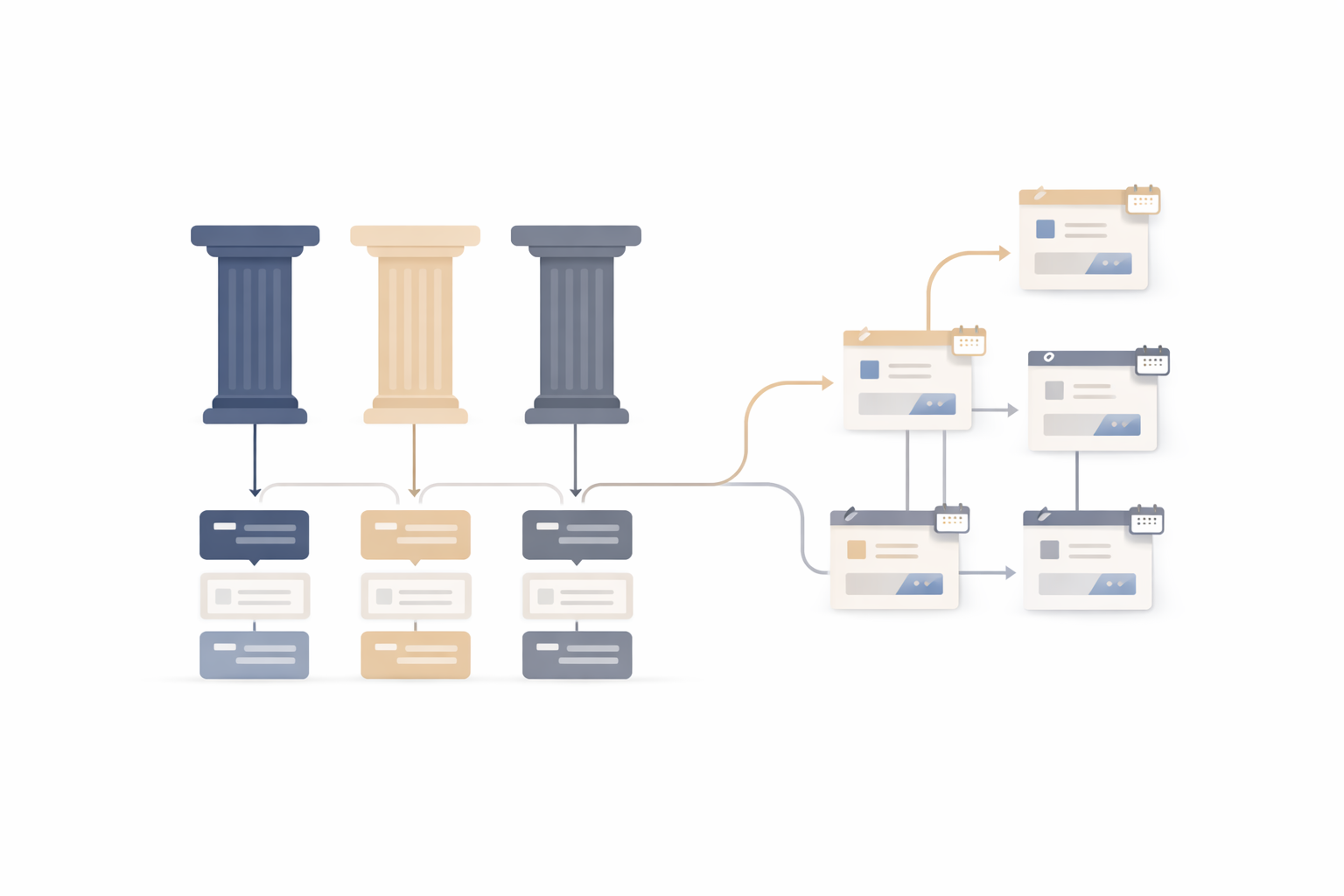
A Quick Example for Small Teams
If your goal is to become a reference account for social media strategy, your pillars might be:
- Social media strategy (why things work)
- Consistency & planning (how to show up sustainably)
- Content reuse (how to get more from what you create)
That’s enough to create dozens of posts — without guessing.
Final Checklist: Are These Good Content Pillars?
A good pillar should be:
- Relevant to your audience repeatedly
- Aligned with your positioning
- Easy to create content for over time
- Broad enough to support multiple post types
- Few enough to repeat often
If your pillars pass that test, you’ll feel an immediate difference:
Less chaos. More clarity. More consistency.
Final Thought
Your content pillars are not just topics.
They are your strategy in repeatable form.
Choose them well, and consistency becomes natural, not forced.